

파쇄 장비Mingyuan Dry and Wet Ball Mill
Customerizable Model for ball mill plant


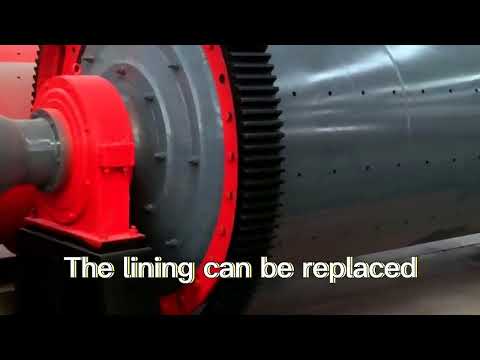


기계 정보
가격 및 위치
- 위치:
- Dahuangye Industrial zone, XinXing East RD, Gongyi, 451200 Zhengzhou, China
제안 세부 정보
- 광고 ID:
- A14536393
- 업데이트:
- 마지막 업데이트: 08.03.2026
설명
A ball mill is a fundamental grinding device used in mineral processing, cement manufacturing, chemical production, and other industrial applications. It works by rotating a cylindrical shell filled with grinding media—usually steel balls—causing impact and friction that reduce materials to fine powder. Based on the grinding environment, ball mills are classified into dry and wet types, each suited for specific materials and process requirements.
Working Principle
Both dry and wet ball mills operate on the same mechanical principle. The rotating cylinder, driven by a motor through a gear system, lifts the grinding media and material along the inner wall. As the rotation continues, the balls fall under gravity, striking and grinding the material. The difference lies in the presence or absence of a liquid medium during grinding.
Dry Ball Mill
A dry ball mill is used when the material must remain moisture-free or when water could affect product quality. It is commonly applied in cement clinker, limestone, quartz, and refractory material grinding. The discharge can be either grate type or overflow type, depending on the desired fineness.
Technical Features:
Feeding size: ≤25 mm
Discharge size: 0.075–0.4 mm
Capacity: 0.65–90 t/h
Liner material: High manganese steel or wear-resistant alloy
Drive system: Gear-driven or direct-coupled motor
Dust control: Equipped with air exhaust and dust collector
Advantages:
Suitable for materials sensitive to moisture
No drying process required after grinding
Lower corrosion risk and simpler maintenance
Easier material classification and separation
Limitations:
Dry grinding produces more dust and heat, requiring efficient ventilation and dust collection systems.
Wet Ball Mill
A wet ball mill operates with water or another liquid medium added to the material. The slurry formed during grinding improves efficiency by reducing friction and preventing excessive heat buildup. It is widely used in ore beneficiation, ceramics, and chemical industries.
Technical Features:
Feeding size: ≤25 mm
Discharge size: 0.074–0.2 mm
Capacity: 0.65–615 t/h
Liner material: Rubber or high-chromium steel
Discharge method: Overflow or grate type
Auxiliary equipment: Classifier, pump, and thickener for slurry circulation
Advantages:
Csdpeq Nx Alefx Apvjhb
Higher grinding efficiency and finer particle size
Reduced dust and noise levels
Continuous operation suitable for beneficiation circuits
Better control of particle uniformity
Limitations:
Requires drying if the final product must be in powder form and involves more complex slurry handling.
The selection between dry and wet grinding depends on the material characteristics, downstream process, and environmental conditions. Dry mills are preferred for materials that must stay moisture-free, while wet mills are ideal for fine grinding and slurry-based processes.
Conclusion
Dry and wet ball mills share the same mechanical structure but differ in their grinding environment and application scope. The dry type offers simplicity and low maintenance for moisture-sensitive materials, while the wet type provides higher efficiency and finer output for mineral and chemical processing. Understanding their technical parameters and operational differences ensures optimal equipment selection, improved productivity, and reliable performance in industrial grinding operations.
공급자
등록일: 2024
50 온라인 광고

문의 보내기
전화기 & 팩스


 Zheng Zhou Shi
 Fine powder grinding mill, clinker millSuperfine ball mill for micro powder

 Fevziçakmak
 TFON MACHINE CO.Leveling Machine || TF-S 3513


 Montbrison
 TOMRAX-TRACT


 Ursberg
 die magnetprofis2023011201


 Fuldatal


 Zheng Zhou Shi
 Double roller crusher /roller sand makerStationary&portable sand crushing plant


 Zheng Zhou Shi
 Rod ball mill / Rod Grinding MillFor Sand and mining beneficiation plant


 Augsburg
 Hosokawa AlpineAS 200 Baseline (RENTAL UNIT)


 Zaleszany
 PGCNC3060ATC 5X


 Zheng Zhou Shi
 Construction waste recycling machineConstruction&demolition management

Machineseeker-신뢰의 인증 마크
신뢰 마크란 무엇입니까?
Machineseeker는 선정된 딜러에게 Machineseeker 신뢰 인증마크를 부여합니다. 발급 전에 숙련된 Machineseeker 직원에 의해 표준화되고 철저한 검사가 수행됩니다.
우리는 무엇을 점검합니까?

영업 허가증 또는 상업 등기부 등본의 확인
판매자의
우편 주소 확인
은행 연결의 검증
대표 번호의
전화
접근 가능성 확인
경제 정보
에는 부정적인 특성이 포함되어서는 안 됩니다
구매자 불만
은(는) 인증 마크 박탈로 이어질 수 있습니다이것이 구매자로서 귀하에게 어떤 의미가 있습니까?
Machineseeker 신뢰 씰을 통해 구매자는 직접 검증하지 않고도 매우 높은 확률로 정직하고 성실하게 거래하는 신뢰할 수 있는 판매자를 식별할 수 있습니다.
물론 구매 과정에서 의견 차이가 발생할 수 있습니다. Machineseeker는 Machineseeker에서 활동 중인 구매자 또는 판매자에 의한 법률 위반에 대해 책임을 지지 않습니다.